

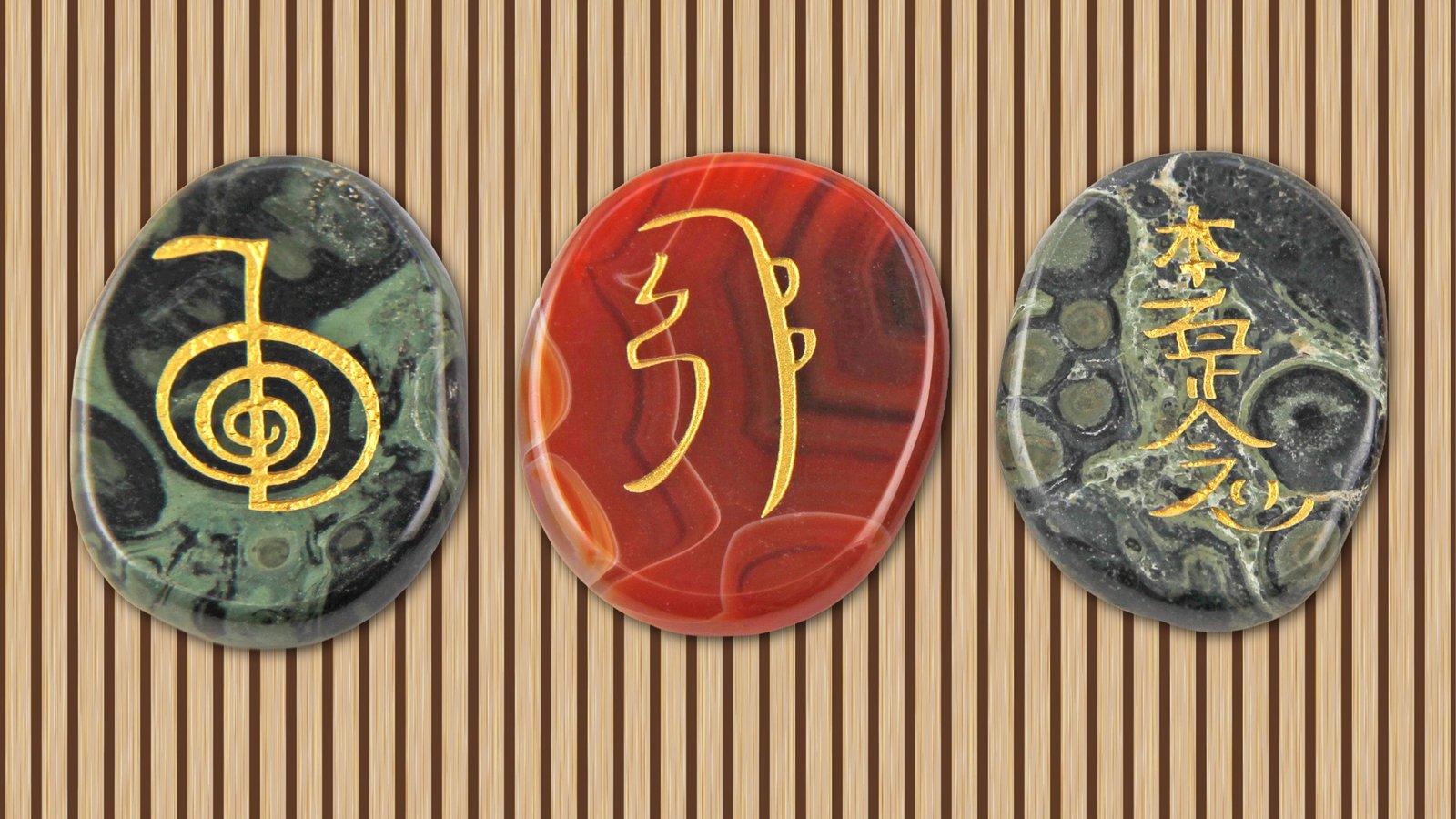
The three Level 2 symbols open new dimensions within Reiki practice.
They can strengthen and focus the flow of Reiki, support emotional harmony, and allow Reiki to be offered beyond immediate physical distance and linear time. They may be used during self-Reiki, with animals who are physically present, and in distance practice.
The three symbols taught at this level are:
- Cho Ku Rei — the Power or Focus Symbol
- Sei He Ki — the Mental, Emotional, or Harmony Symbol
- Hon Sha Ze Sho Nen — the Distance or Connection Symbol
Each symbol has a particular form, name, vibration, and traditional purpose. At the same time, the symbols work together as expressions of one Reiki energy.
They are not separate powers that the practitioner owns. They are sacred forms through which the practitioner connects with particular qualities of Reiki.
What Is a Reiki Symbol?
A Reiki symbol is more than a visual mark.
It has a form, a name, traditional uses, and an energetic quality. Through attunement and practice, it becomes part of the practitioner’s relationship with Reiki.
The symbol provides a focus through which a particular dimension of Reiki may be invoked.
You might think of a symbol as a doorway. Drawing or visualizing it does not manufacture Reiki. Instead, it helps you enter into conscious relationship with an aspect of Reiki that is already present.
The symbols may help you:
- Focus and strengthen Reiki
- Connect with emotional and mental harmony
- Offer Reiki beyond physical proximity
- Work with Reiki in relation to past or future experiences
- Deepen meditation and self-Reiki
- Prepare yourself and the practice space
- Begin or complete a Reiki session with greater clarity
The symbols are not magical commands that force energy to behave in a particular way. They do not give the practitioner authority over an animal, another person, or an outcome.
They support connection.
Reiki continues to flow according to the highest good rather than according to personal control.
Sacredness and Secrecy
Reiki symbols were traditionally passed directly from teacher to student and treated as sacred teachings. Students learned them after receiving the appropriate attunement, and many were asked not to display or reproduce them casually.
Today, the symbols can be found throughout books and online resources. Their public visibility does not remove their sacredness or energetic power.
Seeing a symbol is not the same as being attuned to it. A person may copy its shape, but formal Reiki practice with the symbol begins through attunement and develops through respectful, consistent use.
Sacredness does not need to create secrecy based on fear. It asks for reverence.
You can honour the symbols by:
- Learning their forms carefully
- Using their names respectfully
- Practising them after receiving the Level 2 attunement
- Avoiding casual or trivial use
- Not using them to impress others
- Maintaining ethical intentions
- Remembering that the symbols serve Reiki rather than personal power
- Allowing your understanding to deepen through experience
The symbols do not lose their sacred power because their forms are visible. Their deeper relationship with the practitioner unfolds through attunement, intention, practice, and experience.
Learning the Symbols
Each symbol should be learned in the form and stroke order taught within your lineage.
Small variations appear among Reiki lineages. A spiral may turn in a different direction, a line may curve differently, or the structure of a more complex symbol may vary slightly.
These differences do not automatically make one form correct and another false.
Use the forms given by your Reiki Master Teacher so that your practice remains connected to the attunement and lineage through which you received them.
When learning a symbol:
- Study its complete form.
- Observe the direction and order of the strokes.
- Trace it slowly on paper.
- Draw it repeatedly from memory.
- Draw it in the air.
- Visualize it inwardly.
- Speak or silently repeat its name.
- Invoke it during self-Reiki.
- Record your experience without demanding a particular sensation.
Accuracy matters because attentive practice helps the symbol become familiar. However, anxiety about producing a perfect drawing can interrupt presence.
Learn each symbol carefully, but do not assume that one imperfect line makes Reiki disappear. Your attunement, intention, connection, and sincere practice all participate in the invocation.
How to Draw and Invoke a Symbol
A Reiki symbol may be invoked in several ways.
You may:
- Draw it physically on paper
- Trace it in the air with one or more fingers
- Draw it with the palm of your hand
- Visualize it
- Imagine it as light
- Speak its name aloud
- Repeat its name silently
- Sense its presence without forming a detailed image
Within this manual, the recommended beginning method is:
- Draw or visualize the symbol slowly.
- Repeat its name three times as you draw it.
- Hold a clear intention for its use.
- Pause.
- Allow Reiki to flow.
Repeating the name helps bring together:
- The form of the symbol
- The name of the symbol
- Your intention
- The Reiki quality being invoked
You do not need to invoke a symbol in every possible way at once. Drawing, speaking, and visualizing can be combined, but one clear method may be sufficient.
As your familiarity grows, you may find that simply bringing the symbol into awareness is enough to connect with its quality. While learning, however, take your time.
Draw.
Invoke.
Pause.
Receive.
Cho Ku Rei
The Power and Focus Symbol

Cho Ku Rei is commonly known as the Power Symbol. It is also understood as a symbol of focus, strengthening, activation, protection, and energetic presence.
One widely used interpretation of its name is:
Place the power of the universe here.
Other lineages express its meaning as “Reiki, be here now,” “focus the energy here,” or “the divine power is present.”
These phrases are contemplative interpretations rather than one universally accepted literal translation.
Cho Ku Rei brings Reiki into focused presence. Its shape gathers and directs energy toward a particular point, space, session, or intention.
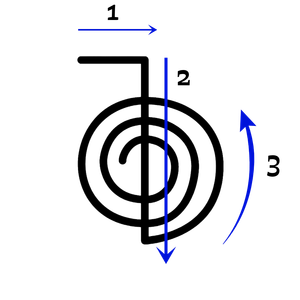
This illustration shows the stroke order for drawing Cho Ku Rei. Follow the numbered lines in sequence, beginning with 1.
The Energetic Quality of Cho Ku Rei
Cho Ku Rei is often compared to an energetic switch because it may activate and strengthen the flow of Reiki. Yet its meaning is deeper than simply turning power on.
The symbol can help gather scattered attention and bring the practice into focus. It invites universal life energy into conscious presence and strengthens the practitioner’s awareness of the Reiki already flowing.
Cho Ku Rei may be used to:
- Begin a Reiki session
- Activate, strengthen, or focus Reiki
- Activate the practitioner’s hands
- Support self-Reiki
- Prepare a room or practice space
- Clear and harmonize the energy of a space
- Bring focused Reiki to an area of the body
- Activate and strengthen another Reiki symbol
- Bless food, water, bedding, or an animal’s belongings
- Create an energetic sense of protection
- Close or seal a session
The word power does not refer to personal dominance. You are not placing your own power over an animal. You are invoking the focused presence of Reiki.
Cho Ku Rei as an Activating Symbol
Cho Ku Rei is commonly used to activate, focus, and strengthen the other Reiki symbols.
A practitioner may draw Cho Ku Rei before another symbol to prepare and focus the Reiki practice. Cho Ku Rei may then be drawn again after that symbol to activate and strengthen its particular energetic quality.
For example:
- Cho Ku Rei → Sei He Ki → Cho Ku Rei may be used when the practice centres upon emotional harmony and balance.
- Cho Ku Rei → Hon Sha Ze Sho Nen → Cho Ku Rei may be used when establishing a connection across distance or time.
- Cho Ku Rei → Sei He Ki → Cho Ku Rei → Hon Sha Ze Sho Nen → Cho Ku Rei brings all three symbols together in a complete layered practice.
When combining the symbols, draw them one over another in the same energetic space, silently repeating the name of each symbol three times as you draw it.
Using Cho Ku Rei in this way does not mean that Sei He Ki or Hon Sha Ze Sho Nen are powerless on their own. Cho Ku Rei creates a focused energetic frame through which the quality of another symbol can be activated and strengthened.
Different lineages may teach different combinations or orders. Within this manual, Cho Ku Rei is commonly used before and after another symbol because of its traditional role in activating, focusing, and strengthening Reiki.
Cho Ku Rei in Animal Reiki
Cho Ku Rei may be used whether the animal is beside you, elsewhere in the room, or receiving Reiki from a distance.
You may invoke it:
- At the beginning of an Animal Reiki session
- Over your hands before offering Reiki
- Within the room or shared practice space
- Near an animal’s bed without drawing directly upon the animal
- During self-Reiki before sitting with your animal
- When offering focused support during a period of change
- To activate Sei He Ki or Hon Sha Ze Sho Nen
- To close the session and release the connection
You do not need to place the symbol directly upon an animal’s body. You may draw it in the air, visualize it within the Reiki space, or invoke it silently.
If the animal is physically present, continue respecting their communication and freedom of movement. Cho Ku Rei strengthens the Reiki offering; it does not override the animal’s choice.
The Direction of the Spiral
Different lineages draw Cho Ku Rei with the spiral turning in different directions.
Some practitioners associate one direction with focusing or strengthening and the opposite direction with clearing or releasing. Other lineages use only one form for all purposes.
Follow the direction taught within your lineage.
It is not necessary to become anxious about accidentally drawing the symbol “backward.” The symbol is connected with your attunement and intention, not with fear of making a mistake.
Learn your lineage form consistently. If you later encounter another form, recognize it as a possible lineage variation rather than immediately assuming that one must be invalid.
A Beginning Cho Ku Rei Practice
After studying the approved symbol form:
- Sit comfortably and bring your hands into Gassho.
- Take several natural breaths.
- Draw Cho Ku Rei slowly in the air before you.
- Repeat its name three times as you draw.
- Visualize or sense the symbol between your palms.
- Place your hands on or above your body for self-Reiki.
- Allow Reiki to flow without forcing intensity.
- Close with gratitude.
Afterward, record what you noticed.
You may feel stronger warmth, pulsing, focus, stillness, or no obvious change. Do not measure the symbol only by physical sensations. Continue practising and allow your relationship with it to develop.
Sei He Ki
The Mental, Emotional, and Harmony Symbol
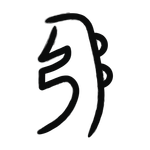
Sei He Ki is commonly known as the Mental and Emotional Symbol or the Harmony Symbol.
It is associated with emotional balance, mental clarity, harmony between different aspects of the self, and the integration of conscious and subconscious experience.
Common contemplative interpretations include:
Earth and sky meet.
and:
The human and the divine become one.
These interpretations express reconciliation rather than division—the meeting of what may appear separate.
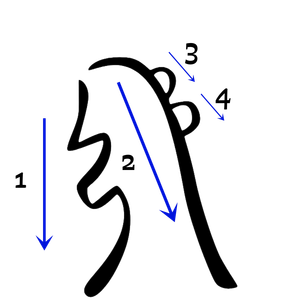
This illustration shows the stroke order for drawing Sei He Ki. Follow the numbered lines in sequence, beginning with 1.
The Energetic Quality of Sei He Ki
Sei He Ki carries a harmonizing quality.
Where Cho Ku Rei gathers and focuses Reiki, Sei He Ki brings attention toward emotional, mental, and relational balance. It may support the gentle release of patterns, the settling of emotional energy, and a greater sense of inner harmony.
Sei He Ki may be used to support:
- Emotional balance
- Mental calm and clarity
- Stressful transitions
- Meditation and self-reflection
- Habit change
- Harmony between thoughts, emotions, and the body
- Healing from difficult experiences
- Harmony within relationships or environments
- A compassionate connection with emotions that have been avoided
- Greater peace during periods of uncertainty
The symbol does not require every difficult feeling to disappear. Emotional healing is not the same as emotional suppression.
Fear, grief, anger, confusion, and sadness may carry meaningful information. Sei He Ki can support balance and integration without requiring a person or animal to stop feeling what they feel.
Sei He Ki in Animal Reiki
Animals may experience emotional stress in connection with changes in their bodies, environments, relationships, and routines.
Sei He Ki may be especially relevant when supporting an animal through:
- Adoption or rehoming
- Separation from a caregiver or animal companion
- Changes within the household
- Travel or relocation
- A veterinary visit
- Recovery after a frightening experience
- Adjustment to a new animal or person
- Grief
- Fear or uncertainty
- Changes associated with ageing
- The loss of a familiar routine
You do not need to know the exact source of an animal’s emotions in order to offer Sei He Ki.
This is particularly important for rescued or rehomed animals whose histories may be incomplete. You may offer Reiki for emotional balance without inventing a story about what happened to them.
The intention can remain simple:
May Reiki support this animal’s emotional balance, sense of safety, and highest good.
Sei He Ki does not give you access to an animal’s private thoughts or memories. Any impression you receive should be held lightly rather than presented as fact.
Activating Sei He Ki with Cho Ku Rei
A recommended sequence for emotional Reiki is:
Cho Ku Rei
→ Sei He Ki
→ Cho Ku Rei
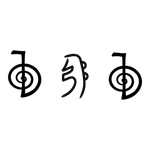
Draw Cho Ku Rei first to establish and focus Reiki.
Draw Sei He Ki over Cho Ku Rei to bring its harmonizing mental and emotional quality into the practice.
Draw Cho Ku Rei again over Sei He Ki to activate, strengthen, and focus that quality.
Silently repeat the name of each symbol three times as you draw it.
This sequence may be used during self-Reiki or when offering Reiki to an animal. It does not mean that you are commanding an emotion to change. You are creating a focused Reiki practice through which emotional balance and healing may be supported.
A Beginning Sei He Ki Practice
Begin with yourself before bringing the symbol into sessions with animals.
- Sit comfortably and enter Gassho.
- Draw Cho Ku Rei and repeat its name three times.
- Draw Sei He Ki over Cho Ku Rei and repeat its name three times.
- Draw Cho Ku Rei again and repeat its name three times.
- Rest your hands over your heart, upper abdomen, or another comfortable position.
- Allow Reiki to support emotional harmony.
- Notice what is present without trying to remove it.
- Close with gratitude.
You may use an intention such as:
May Reiki bring harmony to my thoughts, emotions, body, and spirit. May I meet what arises with compassion and discernment.
If an emotion arises, you do not need to analyse it during the session. Let Reiki flow and allow understanding to emerge in its own time.
Hon Sha Ze Sho Nen
The Distance and Connection Symbol
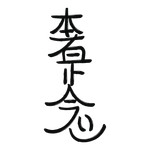
Hon Sha Ze Sho Nen is commonly known as the Distance Symbol.
It is associated with connection beyond physical proximity and ordinary linear time. Through this symbol, Reiki may be offered to an animal in another room, another city, another country, or another time-related circumstance.
Common contemplative interpretations include:
No past, no present, no future.
and:
The divine within me connects with the divine within you.
Another way of understanding the symbol is that the true nature within one being recognizes the true nature within another.
These expressions point toward connection, oneness, and the possibility that Reiki is not limited by ordinary physical separation.
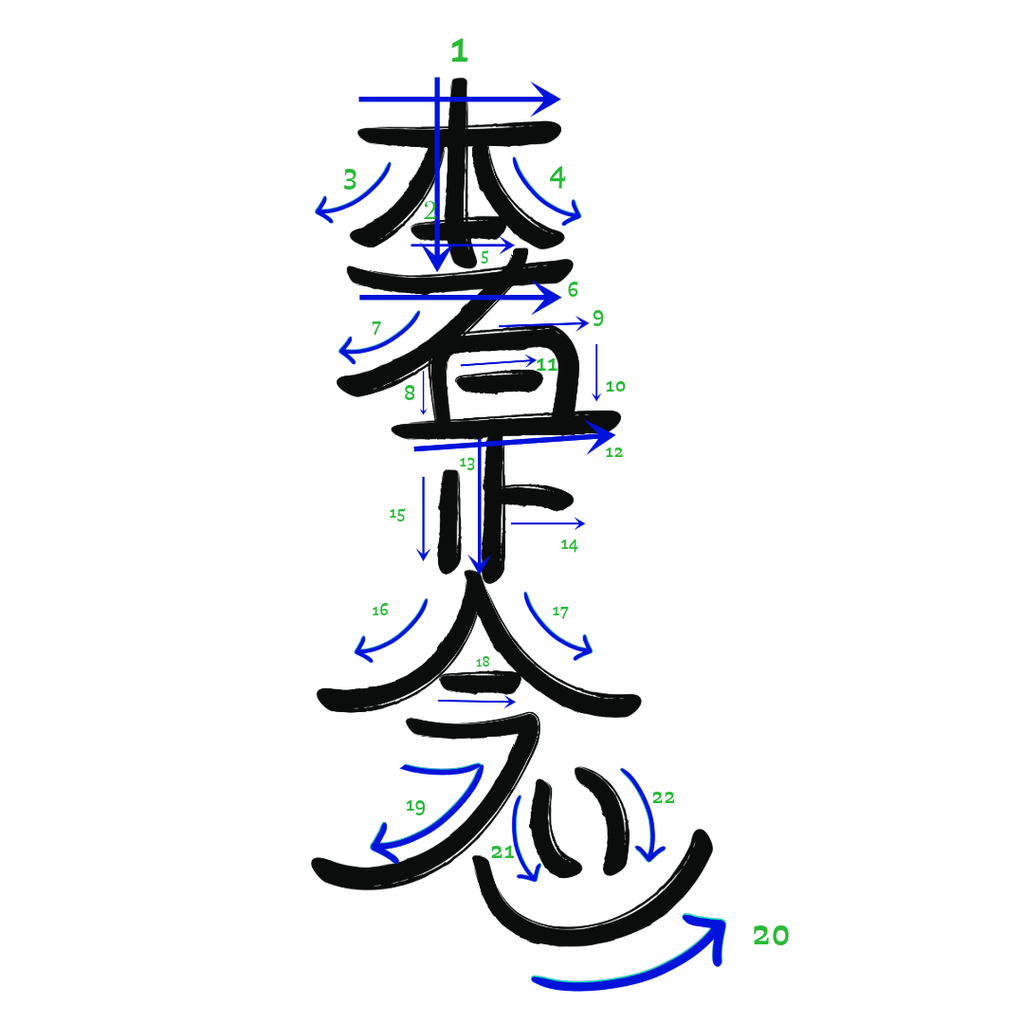
This illustration shows the stroke order for drawing Hon Sha Ze Sho Nen. Follow the numbered lines in sequence, beginning with 1.
The Energetic Quality of Hon Sha Ze Sho Nen
Hon Sha Ze Sho Nen establishes a bridge of Reiki connection.
The symbol does not throw energy across space as though Reiki were a physical object. Instead, it opens the practitioner’s awareness to a level of relationship in which physical distance is not an absolute barrier.
Hon Sha Ze Sho Nen may be used to:
- Offer Reiki to an animal in another location
- Connect with an animal elsewhere in the same building
- Support an animal during a scheduled future event
- Offer Reiki in relation to a past experience
- Work with the emotional influence of earlier circumstances
- Prepare Reiki for a particular time
- Support transitions, travel, relocation, or veterinary appointments
- Deepen meditation upon connection and non-duality
- Connect with an animal, person, place, or situation for an agreed Reiki practice
The symbol is sometimes described as transcending time and space. This does not mean that the practitioner gains unlimited access to another being.
Connection does not remove consent. Oneness does not remove individuality. The symbol allows Reiki to be offered; it does not allow the practitioner to investigate, monitor, diagnose, or control an animal from afar.
Hon Sha Ze Sho Nen and Distance
When offering distance Reiki, Hon Sha Ze Sho Nen is used to establish the connection.
A photograph, written name, visualization, or surrogate may help focus the practitioner’s attention, but these objects do not create the connection by themselves. They serve as practical points of focus.
The full methods of distance Animal Reiki will be taught later in this manual.
For now, understand that Hon Sha Ze Sho Nen is not limited to situations involving great geographical distance. You may use it when:
- An animal rests across the room and prefers not to be approached
- An animal is elsewhere in the home
- An animal is staying at a veterinary clinic
- You are travelling away from your animal
- The caregiver and animal live in another region
- Direct physical presence would create stress
- You wish to offer Reiki without directing attention toward the animal’s body
Distance Reiki can therefore be both geographically distant and physically nearby.
Hon Sha Ze Sho Nen and Time
Hon Sha Ze Sho Nen may also be used in relation to time.
You might offer Reiki:
- In connection with an animal’s earlier experience
- To support the integration of a past transition
- For a future veterinary appointment
- For an upcoming journey
- For a planned move or adoption
- For a time when the animal will be separated from their caregiver
- For an anticipated change in household routine
Offering Reiki to the past does not mean changing historical facts or deciding what an animal’s past experience meant.
Offering Reiki to the future does not mean controlling what will happen.
The intention is to bring Reiki into relationship with the experience for the highest good, allowing healing, balance, and support to unfold without demanding a particular result.
Hon Sha Ze Sho Nen and Oneness
Hon Sha Ze Sho Nen can become a profound symbol of spiritual contemplation.
At the level of ordinary life, you and the animal are distinct beings. You have different bodies, perspectives, experiences, and choices. These distinctions are real and must be respected.
At another level, both of you participate in the same field of life. The universal energy flowing through one being is not fundamentally separate from the universal energy flowing through another.
The symbol invites you to encounter this mystery without using it to erase boundaries.
Non-duality does not mean that you may decide for another being. It means that care offered to another arises within a deeper wholeness to which you both belong.
The more deeply you recognize connection, the more respectfully you can honour individuality.
Activating Hon Sha Ze Sho Nen with Cho Ku Rei
A recommended sequence for connection across distance or time is:
Cho Ku Rei
→ Hon Sha Ze Sho Nen
→ Cho Ku Rei
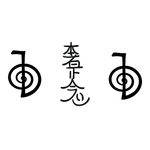
Draw Cho Ku Rei first to establish and focus Reiki.
Draw Hon Sha Ze Sho Nen over Cho Ku Rei to open the connection beyond immediate physical proximity or ordinary linear time.
Draw Cho Ku Rei again over Hon Sha Ze Sho Nen to activate, strengthen, and focus that connection.
Silently repeat the name of each symbol three times as you draw it.
This sequence can be used by itself when the central purpose is establishing a distance or time-related connection. When emotional harmony is also part of the intention, the complete layered sequence may be used.
A Beginning Hon Sha Ze Sho Nen Practice
Begin by using the symbol within self-Reiki rather than immediately attempting a complex distance session.
- Sit comfortably and enter Gassho.
- Draw Cho Ku Rei and repeat its name three times.
- Draw Hon Sha Ze Sho Nen over Cho Ku Rei and repeat its name three times.
- Draw Cho Ku Rei again and repeat its name three times.
- Hold an intention to connect with your own inner wholeness across time.
- Place your hands in a comfortable self-Reiki position.
- Allow Reiki to flow.
- Release the need to understand or change anything.
- Close with gratitude and grounding.
You might hold an intention such as:
May Reiki support harmony among my past, present, and unfolding path. May I receive what serves my highest good.
This practice allows you to become familiar with the symbol’s quality before using it in distance Animal Reiki.
Drawing the Symbols Together
The three symbols do not always need to be used together. The sequence you choose can reflect the purpose of the practice.
For Focused Reiki
Use:
Cho Ku Rei
This may be appropriate when you simply wish to activate, strengthen, or focus Reiki during self-practice or an Animal Reiki session.
For Emotional Harmony
Use:
Cho Ku Rei
→ Sei He Ki
→ Cho Ku Rei
This sequence may be appropriate when the practice centres upon emotional balance, stress, grief, adjustment, separation, rehoming, or environmental change.
For Connection Across Distance or Time
Use:
Cho Ku Rei
→ Hon Sha Ze Sho Nen
→ Cho Ku Rei
This sequence may be appropriate when the animal is in another location or when Reiki is being offered in relation to a past experience or future event.
For a Complete Layered Level 2 Practice
Use:
Cho Ku Rei
→ Sei He Ki
→ Cho Ku Rei
→ Hon Sha Ze Sho Nen
→ Cho Ku Rei
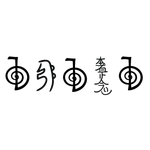
This complete sequence brings together focus, emotional harmony, and connection across distance or time.
It can be especially useful when establishing a distance Animal Reiki session or when an animal’s situation includes an emotional dimension.
A Powerful Layered Symbol Practice
Once you have become familiar with the individual symbols, you may explore a more concentrated Level 2 practice by drawing the symbols one over another in sequence.
The symbols may be layered:
- In the air before you
- Within your visualization
- Over your own hands
- Within the shared Reiki space
- Over an animal’s photograph or written name
- Over a surrogate used for distance practice
- At a respectful distance from an animal who is physically present
If the animal is nearby, avoid sudden hand movements that might startle them. You can draw the sequence discreetly, visualize it, or repeat the symbol names inwardly.
Step 1 — Draw Cho Ku Rei
Draw Cho Ku Rei slowly and deliberately.
As you draw it, silently repeat:
Cho Ku Rei.
Cho Ku Rei.
Cho Ku Rei.
Allow the Reiki practice to become focused and present.
Step 2 — Draw Sei He Ki Over Cho Ku Rei
Draw Sei He Ki over the first symbol.
Silently repeat:
Sei He Ki.
Sei He Ki.
Sei He Ki.
Allow its quality of emotional harmony and balance to enter the practice.
Step 3 — Draw Cho Ku Rei Over Sei He Ki
Draw Cho Ku Rei again over Sei He Ki.
Silently repeat:
Cho Ku Rei.
Cho Ku Rei.
Cho Ku Rei.
Allow Cho Ku Rei to activate, strengthen, and focus the quality invoked through Sei He Ki.
Step 4 — Draw Hon Sha Ze Sho Nen Over the Layered Symbols
Draw Hon Sha Ze Sho Nen over the existing symbols.
Silently repeat:
Hon Sha Ze Sho Nen.
Hon Sha Ze Sho Nen.
Hon Sha Ze Sho Nen.
Allow the Reiki practice to open beyond immediate physical separation and ordinary linear time.
Step 5 — Draw Cho Ku Rei Over Hon Sha Ze Sho Nen
Complete the sequence by drawing Cho Ku Rei once more over Hon Sha Ze Sho Nen.
Silently repeat:
Cho Ku Rei.
Cho Ku Rei.
Cho Ku Rei.
Allow this final Cho Ku Rei to activate, strengthen, and focus the complete layered practice.
Then pause.
Do not rush immediately into the next step. Become quiet and receptive. Allow the symbols to settle into one unified field of Reiki before beginning self-Reiki or offering Reiki to the animal.
The completed sequence is:
Cho Ku Rei
→ Sei He Ki
→ Cho Ku Rei
→ Hon Sha Ze Sho Nen
→ Cho Ku Rei
The repeated use of Cho Ku Rei brings/ focus and Reiki presence into the sequence while Sei He Ki and Hon Sha Ze Sho Nen introduce their particular dimensions of emotional harmony, distance, time, and connection.
The sequence is not powerful because the practitioner is forcing more energy toward the animal. Its power lies in the layered Reiki practice it helps the practitioner enter.
Draw carefully.
Invoke each symbol.
Become receptive.
Offer Reiki.
Then release the outcome.
More Symbols Do Not Always Mean Better Reiki
The complete layered sequence can be powerful, but it is not required for every practice.
Using five symbol invocations does not automatically make a session better than using one. The appropriate choice depends upon the purpose and flow of the practice.
Sometimes Cho Ku Rei alone is sufficient.
Sometimes Cho Ku Rei, Sei He Ki, and Cho Ku Rei form the most appropriate sequence.
Sometimes distance practice calls for Cho Ku Rei, Hon Sha Ze Sho Nen, and Cho Ku Rei.
At other times, the complete layered sequence feels natural.
The question is not:
How many symbols can I use?
The more helpful question is:
Which symbol or sequence supports the Reiki practice I am entering?
Learn the complete sequence and practise it consistently. At the same time, allow simplicity, experience, and your developing relationship with Reiki to guide you.
Symbols, Intention, and Non-Attachment
A clear intention helps orient the practice, but intention should not become a demand.
There is a meaningful difference between:
May Reiki support this animal’s emotional balance and highest good.
and:
This animal must stop being afraid after this session.
The first offers support. The second attempts to dictate an outcome.
The symbols can strengthen and deepen your practice, but they do not make controlling intentions appropriate. Continue to hold space, listen, and release your expectations.
The animal’s path may unfold differently from what you imagine. Reiki may support a change that is subtle, gradual, or expressed in an unexpected way.
Your task is to offer the symbols with clarity and respect—not to prove that they have produced a particular result.
What If You Cannot Feel the Symbols?
Do not force an experience.
Some practitioners notice warmth, tingling, pressure, vibration, spaciousness, emotional movement, changes in breathing, or a distinct sense of energetic presence.
Other practitioners experience something far subtler.
Do not turn sensitivity into a hierarchy. A symbol does not become valid only when you feel dramatic sensations.
Continue practising. Your relationship may deepen gradually.
What If You Cannot Visualize Clearly?
Not everyone experiences mental imagery in the same way.
If visualizing a symbol is difficult, you can:
- Trace it with your hand
- Draw it physically
- Visualize the movement rather than a perfect finished image
- Silently invoke its name
- Bring the symbol into awareness through intention
With repeated practice, you may discover that the symbol becomes familiar in a way that does not depend entirely upon visual imagery.
You may simply know its movement or feel its invocation.
Let your relationship develop naturally.
Let Your Relationship with the Symbols Evolve
At first, deliberate drawing and repetition provide structure.
With experience, you may find that simply thinking of a symbol brings you immediately into relationship with its energetic quality. You may feel less dependent upon consciously drawing every line.
Or the opposite may happen. You may come to appreciate the ritual of drawing the symbols and choose to make them a steady part of your practice for many years.
Neither approach is more advanced.
What matters is whether the symbols continue to support a practice that is present, receptive, respectful, and free from the need to control Reiki.
Learn the forms first.
Then allow experience to teach you how the forms live within your practice.
Practising During the 21-Day Integration Period
During your 21-day integration, spend time becoming familiar with each symbol through daily self-Reiki.
You may structure your practice gradually.
Days 1–7 — Cho Ku Rei
- Practise drawing Cho Ku Rei
- Repeat its name three times as you draw
- Invoke it during self-Reiki
- Notice its quality of focus, activation, and strengthening
- Record your experiences
Days 8–14 — Sei He Ki
- Continue using Cho Ku Rei
- Practise the sequence Cho Ku Rei → Sei He Ki → Cho Ku Rei
- Explore emotional harmony through self-Reiki
- Observe thoughts and feelings without forcing change
- Record what you notice
Days 15–21 — Hon Sha Ze Sho Nen
- Continue practising Cho Ku Rei and Sei He Ki
- Practise Cho Ku Rei → Hon Sha Ze Sho Nen → Cho Ku Rei
- Explore Hon Sha Ze Sho Nen’s relationship with connection and time
- Begin practising the complete layered sequence
- Keep these first practices centred upon self-Reiki
- Record your questions and experiences
This structure allows each symbol to receive focused attention while gradually bringing all three together.
It is not necessary to have a dramatic experience with one symbol before moving to the next. Familiarity grows through repetition, sincerity, and time.
A Complete Layered Self-Reiki Practice
Once you have studied all three symbols, you may use the layered sequence within self-Reiki:
- Prepare your practice space.
- Sit or lie comfortably.
- Enter Gassho.
- State your intention for your highest good.
- Draw or visualize Cho Ku Rei while repeating its name three times.
- Draw or visualize Sei He Ki over Cho Ku Rei while repeating its name three times.
- Draw or visualize Cho Ku Rei over Sei He Ki while repeating its name three times.
- Draw or visualize Hon Sha Ze Sho Nen over the layered symbols while repeating its name three times.
- Draw or visualize Cho Ku Rei over Hon Sha Ze Sho Nen while repeating its name three times.
- Pause and allow the complete sequence to settle.
- Place your hands in a comfortable self-Reiki position.
- Allow Reiki to flow.
- Move your hands intuitively or follow your usual self-Reiki practice.
- Close with gratitude.
- Ground yourself and record any reflections.
You do not need to hold all five drawings continuously in your mind. Invoke each symbol with care, complete the sequence, and then allow the practice to become spacious.
Reiki is not sustained through mental strain.
Your Symbol Journal
During Level 2, consider keeping a section of your Reiki journal specifically for the symbols.
For each practice, record:
- Date
- Symbol or sequence used
- Intention
- How the symbol was invoked
- Sensations or experiences
- Emotions or images that arose
- Questions
- Reflections
If you use the complete layered sequence, you may record it as:
CKR → SHK → CKR → HSZSN → CKR
Over time, look back through your entries.
Has your relationship with each symbol changed?
Do you feel less dependent upon physically drawing it?
Have you developed a deeper appreciation for drawing it deliberately?
Does one symbol feel particularly meaningful?
Does the full sequence bring you into practice differently from an individual symbol?
You do not need to reach a predetermined conclusion.
Observe.
Reflection
Consider the following questions as you begin practising with the symbols:
- How does each symbol feel within my self-Reiki practice?
- Do I expect one symbol to feel stronger than another?
- Can I remain open when I do not notice an immediate difference?
- Which symbol do I feel naturally drawn toward?
- Which symbol asks for more patience or practice?
- What does power mean when I remember that I am a conduit?
- How does Cho Ku Rei change my experience of another symbol?
- What do I notice when I layer the symbols?
- How can emotional harmony include rather than suppress difficult feelings?
- What does connection beyond distance mean to me?
- How can I contemplate oneness while continuing to honour boundaries?
- Am I using the symbols to support Reiki, or am I trying to control an outcome?
- Which symbol or sequence feels most appropriate for my current practice?
Let your answers develop through experience. Intellectual understanding is helpful, but the symbols become meaningful through direct relationship.
Looking Ahead
You have now been introduced to the forms, meanings, and primary qualities of the three Level 2 Reiki symbols:
- Cho Ku Rei, which activates, focuses, and strengthens Reiki
- Sei He Ki, which supports mental and emotional harmony
- Hon Sha Ze Sho Nen, which establishes connection beyond immediate physical distance and ordinary linear time
You have also learned how Cho Ku Rei may be used to activate the other symbols and how the symbols may be layered in the sequence:
Cho Ku Rei
→ Sei He Ki
→ Cho Ku Rei
→ Hon Sha Ze Sho Nen
→ Cho Ku Rei
In the next chapter, you will explore integrating the symbols through self-Reiki. You will learn how to develop a personal relationship with each symbol, incorporate them into daily practice, and deepen your understanding throughout the 21-day integration period.
Begin slowly.
The symbols do not need to be mastered in a single day. Let them become familiar through respectful repetition, direct experience, and the quiet unfolding of Reiki within your own life.